
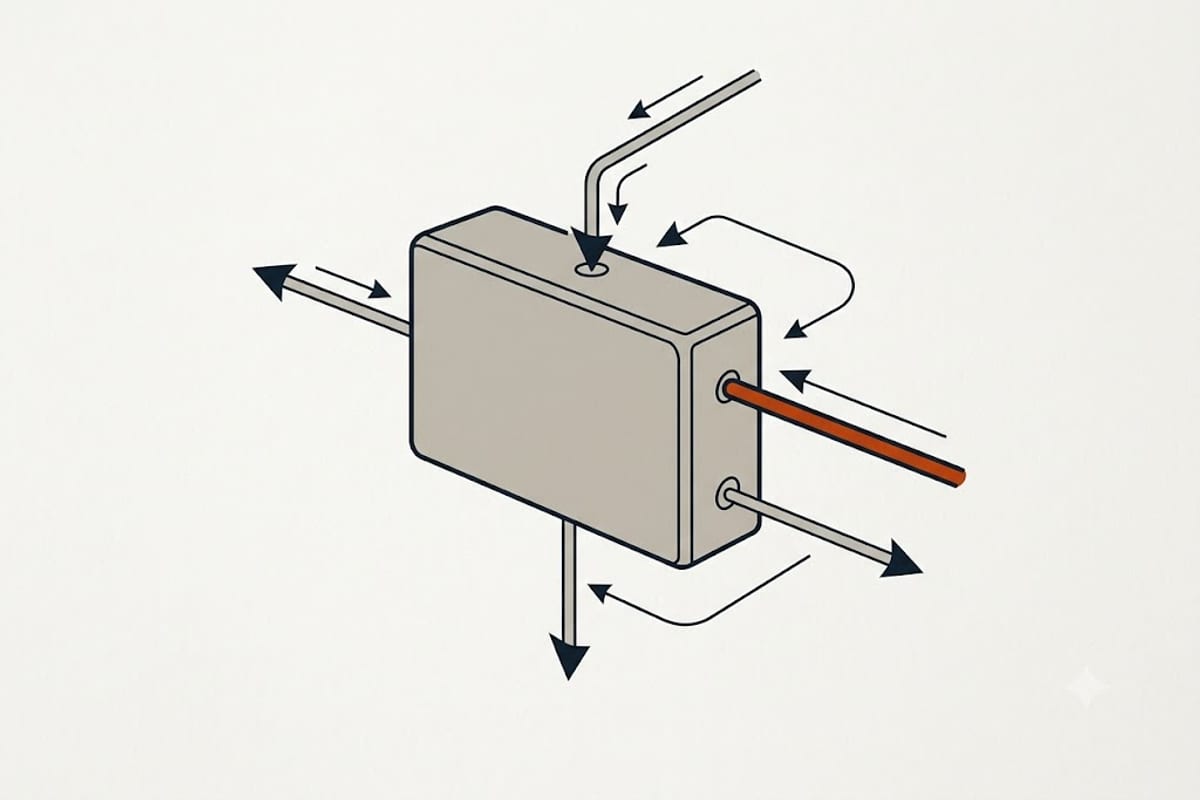
A whole-house gas tankless heater is a compact appliance with four separate service requirements.
The gas supply
Whole-house units run to roughly 199,000 BTU/h, which is several times a typical storage water heater and comparable to a large furnace.
The gas line from the meter is sized on demand and distance, and a line adequate for a 40,000 BTU tank is rarely adequate for a tankless unit. Larger pipe, and sometimes a run in a larger size for most of the distance.
The meter may need upgrading, since the house's total demand now includes this appliance at full rate. That is a utility job with a utility lead time.
Undersized gas supply is the most common tankless installation fault, and the symptom is a unit that works until another gas appliance fires, then fails to maintain temperature.
The venting
Condensing units vent in PVC or polypropylene through a sidewall, with a concentric or two-pipe arrangement for exhaust and combustion air.
Non-condensing units need stainless steel category III venting, which is considerably more expensive per foot.
Either way it is a new penetration with clearance requirements from windows, doors, air inlets, gas meters and the property line — the same considerations as any sidewall-vented appliance.
The old flue is abandoned. If a furnace or another appliance shares it, that appliance is now on an oversized cold chimney, with the draft and condensation problems that follow. The remedy is relining or converting that appliance, and it belongs on the quote.
The condensate
A condensing unit produces acidic condensate that needs a drain, a trap, and often a neutraliser depending on the drain material and local requirements.
A line run through an unheated space will freeze, which locks the unit out — reliably in the coldest week.
The electrical supply
Even a gas tankless unit needs power for its controls, fan and ignition, and that is a dedicated circuit.
It also means the unit does not work during a power outage, which an atmospherically vented storage heater would.
Water side
Isolation and service valves on the inlet and outlet, with ports for flushing. These make annual descaling a twenty-minute job instead of a plumbing job, and they cost very little at installation.
A pressure relief valve, plumbed to a safe discharge.
A sediment filter where the water carries particulate, since the heat exchanger passages are narrow.
Descaling
Tankless heat exchangers scale in hard water, and scale restricts flow and reduces output.
Manufacturers specify an interval — commonly annual in hard water, less often in soft. With service valves it is a matter of circulating a descaling solution for an hour.
Skipping it is what produces a five-year-old unit delivering half its rated flow, and warranty terms frequently require it to be documented.
What to confirm on a quote
The gas line size and whether the meter is adequate. The vent material, route and termination. The condensate route and whether it passes through unheated space. Whether service valves are included. And what happens to any other appliance on the old flue.
Those five between them account for most of the difference between a tankless quote that is complete and one that is not.
Point-of-use units
Small electric tankless heaters at a single fixture are a different product with none of these requirements beyond a circuit.
They suit a remote basin, a garage sink or a bar sink a long way from the water heater, where the alternative is a long wait and a lot of wasted water.
They do not scale to a shower, and an electric whole-house tankless unit needs an electrical service most houses do not have.
Freeze protection
A tankless unit mounted on an exterior wall or in an unheated space contains a small volume of water that can freeze and split the heat exchanger.
Most units have built-in freeze protection that requires them to stay powered, which means a power outage in a cold snap is a risk. Manufacturers publish the temperature limits and the recommended precautions, and an outdoor-rated unit in a cold climate needs both the electrical supply maintained and, sometimes, draining.